30 Days Money Back Gaurantee. Have questions? Email us at contact@needoh.co.uk
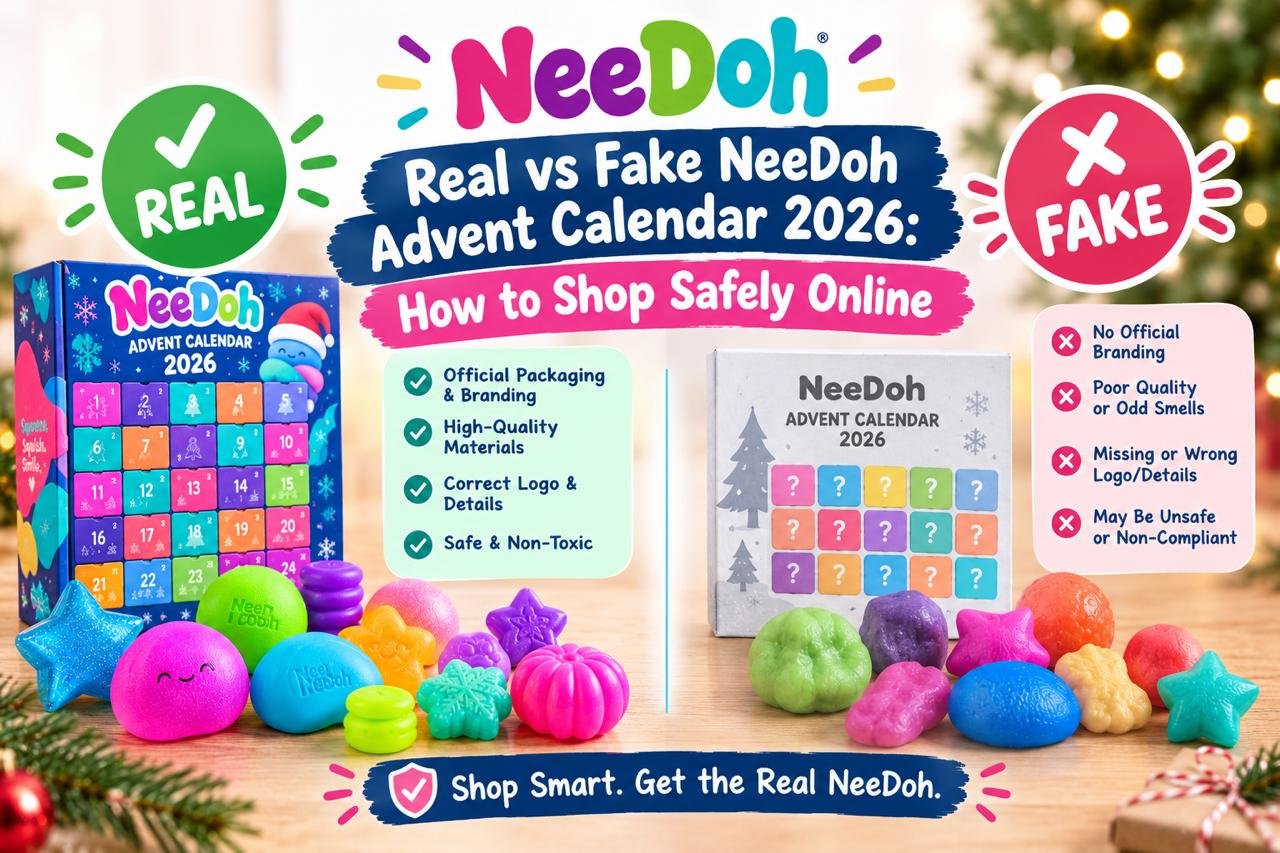
A suspiciously cheap NeeDoh Advent Calendar can look like a brilliant Christmas bargain—until the box arrives with the wrong branding, missing toys or squishies that don’t feel right. This real vs fake needoh advent calendar guide explains what to check before you pay, where the risks are highest and what to do if something doesn’t look genuine.
The safest starting point is simple: buy from a retailer you can identify, check the listing carefully and make sure you have a clear returns route. A product photo alone isn’t enough, especially when marketplace listings can change quickly.
Real vs fake NeeDoh advent calendar: the quickest checks
There isn’t one visual clue that proves every calendar is genuine. Counterfeit packaging can copy the general look of a popular product, so use several checks together rather than relying on a single logo or a low price.
- Check the seller’s identity. Look for a named business, UK contact details, customer support and a clear refund policy—not just a product image and a “buy now” button.
- Read the product title carefully. A listing that uses NeeDoh in the title but quietly describes a different brand, “inspired” product or generic squish calendar deserves caution.
- Look closely at the packaging images. Spelling mistakes, blurred logos, awkward wording, inconsistent fonts and poor-quality printing are warning signs.
- Compare what the listing promises. The Schylling product page is reported to describe a calendar containing 24 unique Teenie NeeDoh toys, with one behind each door. A listing that gives different contents should be checked before ordering.
- Check the age guidance and safety information. Schylling’s listing reports an age recommendation of 3+ and a small-parts choking warning. Missing or contradictory safety information is a reason to pause.
- Keep screenshots. Save the product description, seller name, price, delivery promise and photos before checkout. Marketplace pages can be edited after you order.
None of these checks replaces a retailer’s accountability. They simply help you spot a risky listing before money changes hands.
Why online listings need extra care in 2026
Popular seasonal toys attract lookalike listings because shoppers are often searching in a hurry. Stock can be limited, prices can jump and a familiar product name may appear alongside unrelated third-party items.
The research supplied for this guide reports that 2026 marketplace results include lookalike calendars and third-party listings appearing beside genuine products. Reported problems include incorrect branding, sticky or poor-quality squishies, missing NeeDoh toys and products that don’t match the advertised texture.
That doesn’t mean every marketplace listing is fake. It does mean you should separate the platform from the seller. “Sold on” a familiar marketplace isn’t the same as “sold by” a retailer you can identify and contact.
Schylling’s NeeDoh website is also reported to warn that counterfeit websites may take payment without sending products and to direct shoppers towards an authorised-dealer directory for the United States and Canada. That directory is useful context, but it doesn’t automatically establish that a particular UK listing is genuine.
What genuine product details should look like
A genuine listing should give you enough information to understand what you’re buying. For the NeeDoh Advent Calendar, the Schylling product page is reported to identify Schylling as the maker, describe 24 mini Teenie NeeDoh sensory toys and recommend the product for children aged 3 and up.
The same product information is reported to give each mini toy an approximate height of 1.25 inches, show a suggested price in US dollars and describe seasonal availability from November through December. Those details come from a US product page, so don’t treat the dollar price as a UK selling price or as a fixed UK recommended retail price.
Use the manufacturer’s description as a comparison point, not as permission to ignore the retailer. A trustworthy UK listing should still explain who is selling the item, how it will be delivered and what happens if it arrives damaged, incorrect or not as described.
Packaging clues to examine
- Is “NeeDoh” written consistently throughout the box and product description?
- Does the packaging look sharp and professionally printed, or are images pixelated and text distorted?
- Are the contents described clearly rather than vaguely as “24 surprise toys”?
- Does the age guidance appear on the packaging or listing?
- Is there safety information instead of unexplained claims about the toy?
Be careful with comparison photos found on social media. They can help you notice differences, but an image may show a different edition, a damaged box or a product from another market. Treat online posts as leads, not final proof.
Seller checks that matter more than a bargain price
Price is a clue, but it isn’t a certificate of authenticity. A genuine item may be discounted, while a fake listing may be priced close to the expected amount to appear convincing.
Before ordering, open the seller’s business information and look for:
- a real company or shop name;
- a working customer-support route;
- delivery information that applies to the UK;
- a refund or returns policy you can actually read;
- clear wording about whether the item is in stock;
- payment through a recognised checkout rather than an unusual direct-transfer request.
On NeeDoh Cube UK, you can review the UK shipping policy and refund policy before buying. The store also provides a contact page for customer support. These practical details won’t prove the origin of every product across the internet, but they give you a clearer route to help when buying from this store.
You can also browse the store’s NeeDoh Advent Calendar listing or the wider NeeDoh Christmas toys collection. Check the live listing for current availability and product details rather than relying on an old search snippet.
Safety signs you shouldn’t brush aside
NeeDoh toys are sensory fidget toys, not medical devices. They may be chosen as sensory support or a focus aid, but they shouldn’t be presented as a treatment or cure for ADHD, autism, anxiety or any other condition.
For an advent calendar, the age guidance matters because it contains small individual toys. Schylling’s product listing is reported to recommend the calendar for ages 3+ and to include a small-parts choking warning. Follow the product’s current packaging and listing, and don’t give it to a child below the stated minimum age.
The dough-like filling also means the toys should be treated as squishy sensory products, not as objects for chewing or rough handling. Keep them away from sharp objects, teeth and excessive stretching. If a toy splits or leaks, stop using it, keep the material away from children and pets, clean the area and contact the retailer.
NeeDoh Cube UK states that its NeeDoh products are non-toxic, BPA-free, phthalate-free and latex-free, and that the products it sells comply with UK toy safety standards. If a particular listing doesn’t provide sensible safety information, don’t assume that a familiar-looking logo makes it safe.
What a real counterfeit warning looks like
There is a confirmed warning worth taking seriously from Ireland’s consumer-protection authority. The Competition and Consumer Protection Commission reported a recall of a fake or counterfeit NeeDoh Advent Calendar sold by one retailer in Ireland. The authority stated that the product was not authentic, lacked the required CE marking and should not have been sold; the notice referred to approximately 30 affected products.
This does not prove that every unusual-looking calendar is part of that recall. It does show why missing safety markings and questionable supply chains are more than cosmetic concerns.
If your calendar arrives and you suspect it’s counterfeit, don’t open every door or let a child play with the contents. Photograph the packaging, product, seller details and any missing or incorrect information. Ask the retailer for a refund, and report the issue to the marketplace or relevant consumer-safety authority if the seller doesn’t resolve it.
What to do if you’ve already bought a suspicious calendar
First, stop and document. Keep the packaging, delivery label and payment confirmation, then take clear photographs of the front, back, barcode, safety information and each toy if you’ve already opened the calendar.
- Contact the seller through the original order or website contact route.
- Explain exactly what differs from the listing: incorrect branding, missing contents, poor texture, spelling errors or absent safety details.
- Request a refund and keep copies of all messages.
- Use the marketplace’s buyer-protection process if the seller doesn’t respond.
- Contact your payment provider if the transaction appears fraudulent.
- Don’t pass the calendar on to another child while its authenticity or safety is uncertain.
A retailer may need the item returned, so follow its instructions and don’t throw away evidence too soon. If the toy has leaked, avoid direct contact with the filling and follow the seller’s advice for disposal.
Sources and verification
Each row below says what the source was used for and how the page was read. A row marked as a search summary was not opened in full, so it was not treated as independent confirmation.
| Source | Type | What we used it for |
|---|---|---|
| NeeDoh Advent Calendar | 24 Days of Sensory Squish Surprises | Manufacturer / brand page (first-party) | The official product page identifies Schylling as the maker, lists 24 unique Teenie NeeDoh toys, a USD 29.99 price, ages 3+, a choking warning, and seasonal November–December availability. |
| NeeDoh: The Original Squish, Since 1975 | Schylling | Manufacturer / brand page (first-party) | Schylling says it is the official NeeDoh source, warns that counterfeit sites may take consumers’ money without delivering products, and provides an authorized-dealer directory for the United States and Canada. |
| Hugmie Recalls Fake/Counterfeit NeeDoh Advent Calendar Toy | CCPC | Independent secondary guide | Ireland’s consumer-protection authority reported a recall of a counterfeit NeeDoh Advent Calendar, stating that the product was not authentic, lacked the required CE marking, and should not have been sold. |
| Schylling NeeDoh Advent Calendar, 24 Days of Surprise Mini Squish Sensory Toys | Platform listing | The Walmart listing identifies the product as a Schylling NeeDoh calendar, reports 24 mini sensory toys, and shows marketplace ratings and pricing that can be compared with suspicious listings. |
| Funky Frights Toy, Squish Countdown Advent Calendar 2026 | Walmart | Platform listing | This third-party listing is marketed as a 2026 squish calendar rather than an official Schylling product; customer reviews describe it as a NeeDoh knockoff with incorrect contents and a different texture. |
Should you buy a NeeDoh Advent Calendar online?
Yes, online buying can be sensible if you choose a retailer with visible business details, UK delivery information and a clear refund route. The risk rises when a listing is vague, the seller is difficult to identify, the price is presented as an urgent one-off bargain or the product description contradicts the manufacturer’s reported details.
For a calmer checkout, start with the retailer rather than a random advert. Compare the listing with the reported Schylling details, read the safety information and save your order confirmation. If you’re buying for a child, remember that the calendar contains small sensory toys and follow the stated age guidance.
Ready to check availability? Visit the NeeDoh Advent Calendar product page, review the current information and use the store’s FAQ or contact page if you need help before ordering.